
ATELIER KAMPOT
Architectural Review New into Old 2019 - SHORLISTED
DEZEEN Awards 2019 _ LONGLISTED
Digital publication: Archdaily / DesignBoom ...
Evolving Heritage:
Extending the Legacy of an Historic Kampot Shophouse
Our first project in Cambodia embraced the delicate balance of renovating a vintage shophouse in Kampot. Originally built a century ago, its long life had culminated in twenty years of abandonment. Termites had ravaged the wooden floors and beams, rendering the structure unsound, and the colonial façade had fallen into disrepair. The building embodied the nostalgia of the riverside community but was not built to adapt to the current century. We faced a classic architectural dilemma: to preserve it in its charming, vintage state or reinvent it into a typology relevant for contemporary Kampot.


The spirit of its heritage was most appreciable in its crumbling colonial façade, renovated in 1949 to feature decorative columns, arches, and shutters. Restoring this to a fresh state of authenticity allowed us to preserve the building’s historical character while enabling bolder renovations inside.

To equip the building securely for continued use, it needed a complete rebuild internally, from the foundations up. With the freedom to repurpose the space, we focused on making it adaptable to the dual functions of commercial and residential use that are iconic to the shophouse typology. Although it was initially pegged for residential use, we wanted to maintain the option of using the ground floor as a commercial space. At the same time, we resisted completely opening up the street-facing walls for business activity to preserve its function as a residence.

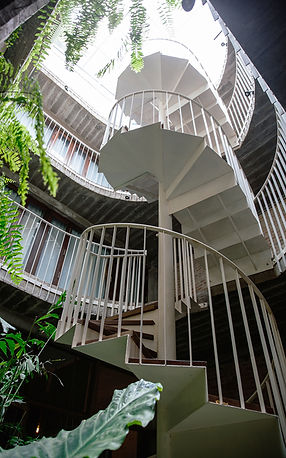
Adjusting for potential commercial and residential needs necessitated an opening-up of the space internally. To bring in light and ventilation to the previously dark building, an internal courtyard was developed, hosting a spiral staircase that opens to the sky and connects each of its three floors. This feature creates an introspective green space as a counterpoint to the bustling riverside location. It also allows for innovative use of vertical space in the split-level, multi-purpose work and living area.

During construction, it was decided to create a public café restaurant on the ground floor—an uncomplicated redesign thanks to the adaptability of the original program. Its exposed brickwork, floorboards, beams, and columns draw public attention to the raw materials that connect it to its environment and history.


Due to its remote location and the difficulty to access the inside without having to demolish the delicate old façade, BLOOM had to design the whole project capable to be built on site by autochthone workforce.


The courtyard now acts as a physical separation between the public and private spaces. However, the upper floors are not disconnected from the locale. Cement-tiled balconies with shuttered doors and windows provide a filtered appreciation of the riverside view and back alley, inviting in just enough of the compelling qualities of its urban location.

Heritage is a dynamic process, requiring reinvention as well as preservation to ensure the spirit of a building can last. By equipping the vintage shophouse for adaptability, we have ensured its role in the urban fabric of Kampot. As a popular café and restaurant, it once again contributes to the community streetscape, but it can also easily transform to another more insular function, should the need arise.
As a measure of its acceptance, neighbors have started to restore—and even replicate—new colonial façades, cementing a commitment to heritage in a changing region.